


Part two
PRINCIPLES OF COMPOSING MUSIC
IN AZERBAIJANI MODES IN FOLK STYLE
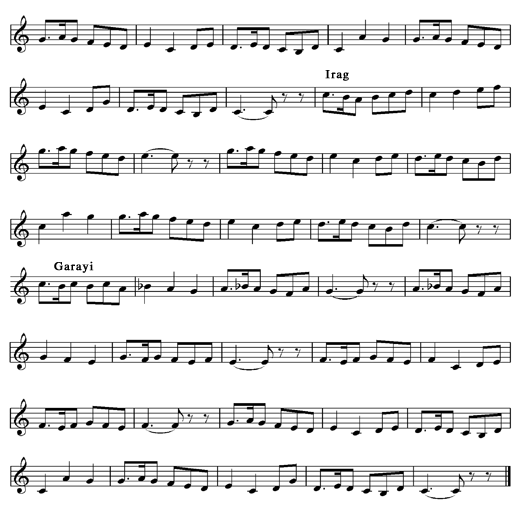
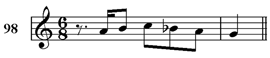
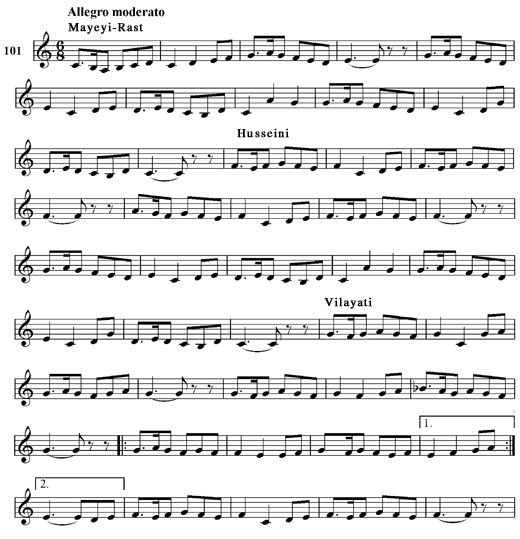
I. STRUCTURE OF PERFECT QUARTESIn "Iraq" the tonic of the mode "Rast", as well as the whole scale, is moved an octave upwards . Therefore, "Maye-Rast" shifted for one octave higher, can form the melody of the section "Iraq". "Iraq" can also have its own melody composed on the principles of formation of "Maye- Rast", but in order to preserve the thematic unity of the work, it is better to use the melody of "Maye-Rast" in its entirety.
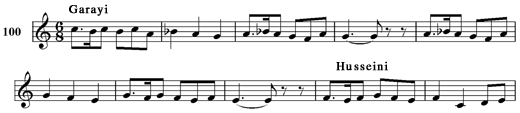
After "Iraq" it is necessary to response to the initial position. It is done through "Garayi". For "Garayi" one must understand the change of the leading note si by the boundary tone of the scale in its initial form (si-flat). And it is also done not by the application of chromatic scale, but by octave leap of the tonic to the lower mediant. In this case the function of the mediant is substituted by the function of the supertonic, thereby enabling it to move to the boundary tone.
Sometimes a move from the tonic octave directly to the boundary tone is also permitted.
There are cases when the boundary tone is evaded, as the lower quarte and the lower mediant of the tonic octave act in the function of the tonic quinte and the supertonic of the same quinte simultaneously.
After substitution of the main tone by the boundary tone the first sentence of "Garayi" ends as "Vilayeti", in the quinte of the tonic in the beginning of the 4-th bar; then it is followed by the response sentence with a stop in the tonic third. Then the section "Husseini" wholly comes, i. e. with the end in the tonic of the mode.
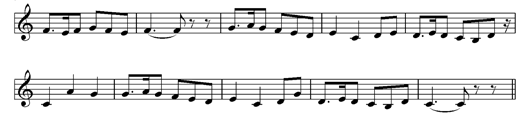
Thus, all the compositions in the mode "Rast" may be represented as follows:
[ Rast: pages 1 2 3 4 5 6 ]




 ©
Musigi Dunyasi
©
Musigi Dunyasi